
Patient referral tracking means logging every referral from the moment it is received until the patient is confirmed connected to care, or a documented reason ends it. A referral that was sent but never confirmed is not finished work. For behavioral health teams, the practical version is simple: one record per referral, one named owner, a status that changes as things happen, and a follow-up date that never sits empty.
This guide covers what to track, which statuses to use, how to measure delays, and what privacy rules apply. It is written for admissions teams, case managers, consultants and sober living operators.
TeryliKeep Behavioral Health Referrals MovingTeryli helps behavioral health teams manage referral information, track statuses, and coordinate follow-ups in a dedicated workspace.Explore TeryliTL;DR
-
Track a referral until closure, not until it is sent. Federal guidance recommends logging every request through completion.
-
Each referral needs an owner, a status, a next action and a follow-up date. Without those four, it drifts.
-
Measure the percentage of loops closed, plus no-shows, cancellations without rescheduling, and referrals never scheduled.
-
PHI in a tracker falls under HIPAA and state law. Substance use disorder records may also fall under 42 CFR Part 2.
-
A shared workspace beats spreadsheets and inboxes once more than one person touches the same referral.
Table of Contents
What patient referral tracking covers
A referral has two sides. The referring team decides a patient needs another service and sends the request. The receiving program decides whether it can accept the patient, schedules intake, and reports back. Tracking is the record that follows both sides.
The Centers for Medicare & Medicaid Services recommends logging and tracking every referral request through completion. The Institute for Healthcare Improvement adds that tracking should be patient-level, reliable, easy to use, and kept going until closure rather than stopping once a referral goes out.
California’s Department of Health Care Services gives a precise definition in its Medi-Cal guidance. A closed-loop referral is tracked, supported and monitored, and ends in a known closure, such as the member receiving services. That rule applies to Medi-Cal managed care in California. The logic carries over to any behavioral health setting: the loop closes on a known outcome, not on silence.
Why behavioral health feels the gap more
Behavioral health referrals move fast and fail quietly. A bed opens for a day. A family calls three programs. A patient is ready on Tuesday and ambivalent by Friday. Referrals also cross organizations that do not share a system: a treatment center, an outpatient group, a sober living home, an independent consultant.
The scale of the problem is documented. CMS’s guide says up to 50% of referrals are not completed, and completed referrals often lack a note sent back to the referring practice. The Government Accountability Office found that for fiscal years 2021 to 2024, VA facility staff made 602,472 behavioral health referrals that VA considered complete, while another 273,710 lacked an associated claim and were not considered complete as of January 2026. That is a large system, but the pattern is familiar to any small admissions desk: some referrals simply never show a result.
What information to track
A useful referral record is short. Every extra field is a field someone skips. The set below covers what most behavioral health teams need.
Who and what
-
Patient or client identifier (minimum necessary, see the privacy section)
-
Referral source: person, organization, channel
-
Receiving program and the contact at that program
-
Level of care or service requested
-
Urgency: routine, urgent or emergent
Where it stands
-
Date received and date sent
-
Current status (see the next section)
-
Owner: one named person, not a team inbox
-
Next action and follow-up date
How it ended
-
Outcome: admitted, declined, no-show, withdrew, lost to contact
-
Reason, when declined or closed without services
-
Date services started
-
Whether a note or discharge information came back
The fields on the second list do the heaviest lifting. Owner, next action and follow-up date turn a log into a work queue.
Keep operations next to the clinical record
The tracker does not need to hold clinical notes. Operational coordination (who owns this, what happens next, when to check again) can sit alongside the clinical record. Keeping the two separate also limits how much sensitive data lives in the tracker.
Referral statuses that hold up in practice
Status labels should describe what actually happened, in an order that matches the work. Federal examples are a useful base. CMS says receiving practices should tell the requesting practice the referral disposition, appointment date and time, inability to schedule, inappropriateness, cancellations and no-shows.
The VA’s community care process shows a full lifecycle. A referral is received and approved, assigned to a community provider, accepted or rejected, followed by a first appointment and initial care. It ends when final medical documentation is received and the episode of care is complete. GAO describes the same sequence for VA behavioral health: create the referral, send it, schedule the visit, confirm that it occurred, and close the referral after confirmation.
A behavioral health team can adapt that into a working set:
| Status | Meaning | Typical next action |
|---|---|---|
| Received | Request logged, owner assigned | Review fit and urgency |
| Sent | Packet delivered to the receiving program | Confirm receipt |
| Under review | Program is evaluating | Follow up on the agreed date |
| Accepted | Program will admit or schedule intake | Confirm date and logistics |
| Declined | Program cannot take the patient | Record the reason, redirect |
| Scheduled | Intake or first appointment is set | Reminder before the date |
| Arrived | Patient attended | Confirm services started |
| No-show or withdrew | Patient did not connect | Outreach, reschedule or close |
| Closed | Known outcome recorded | Archive, report |
Two details matter. First, a decline is a valid status, not a failure of the log. In the VA workflow, community providers can accept or reject a referral, and when one is rejected the Referral Return Reason field is mandatory. Requiring a reason makes the data usable later. Second, “closed” should never be the default for “nobody answered.” Use a distinct status such as lost to contact so the number stays honest.
A referral from receipt to closure
The timeline below shows a typical admissions-to-placement path. Times are illustrative.
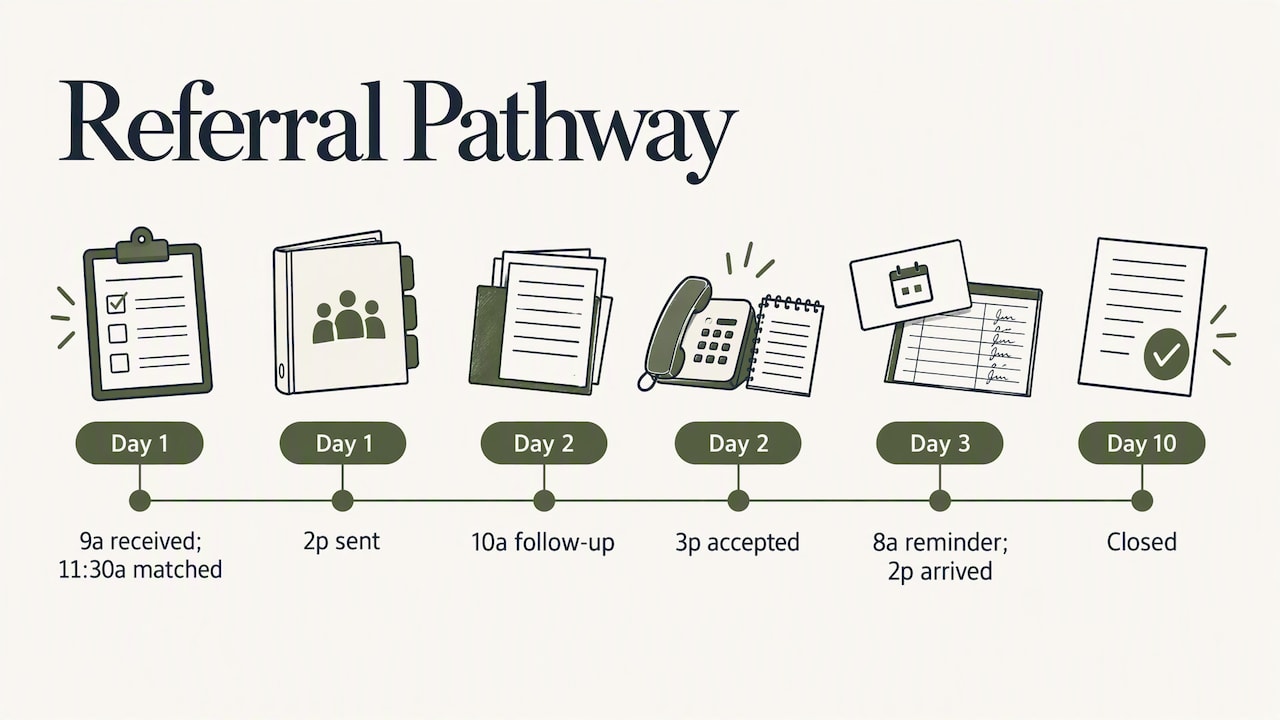
Day 1, 9:00 a.m. Received. A family contact submits a request. The admissions coordinator logs it, assigns an owner and marks urgency.
Day 1, 11:30 a.m. Matched. The owner searches for programs that fit level of care, location and payment type. Three candidates go on the record.
Day 1, 2:00 p.m. Sent. The packet goes to the first program. The status changes to sent, and a follow-up is set for the next morning.
Day 2, 10:00 a.m. Follow-up. The program has not replied. The owner calls, logs the call and resets the follow-up.
Day 2, 3:00 p.m. Accepted. The program confirms a bed and an intake time. Logistics are noted.
Day 3, 8:00 a.m. Reminder. The patient is contacted before the scheduled arrival.
Day 3, 2:00 p.m. Arrived. The receiving program confirms. The status moves to arrived.
Day 10. Closed. The receiving program reports that services started and sends a brief note. The loop is closed with a known outcome.
Nothing in that sequence is complicated. What breaks it is the missing owner on Day 1 and the missing follow-up on Day 2.
Assign roles before choosing tools
CMS recommends process-mapping the referral workflow, identifying gaps, and assigning team roles and responsibilities. The Improving Primary Care Team Guide takes the same view of accountability: the referring practice should stay accountable for timely services, help patients schedule, and track progress and results. In behavioral health, that often means the case manager or admissions coordinator owns the referral until a receiving program confirms the patient arrived.
How to spot delays and measure completion
Three numbers tell most of the story.
-
Loop closure rate. CMS identifies the percentage of referral loops closed as a core measure.
-
Gaps in the flow. The same guide points teams to no-shows, cancellations without rescheduling, and referrals never scheduled.
-
Time in status. How long referrals wait at each step shows where the delay lives.
A practical way to start is to take a small sample. A step-by-step process guide suggests tracking 20 referrals from receipt to completion, noting the time at each step and where delays occur. Twenty referrals is enough to see whether delays cluster at sending, at program response, or at patient scheduling.
What regulators expect on cadence
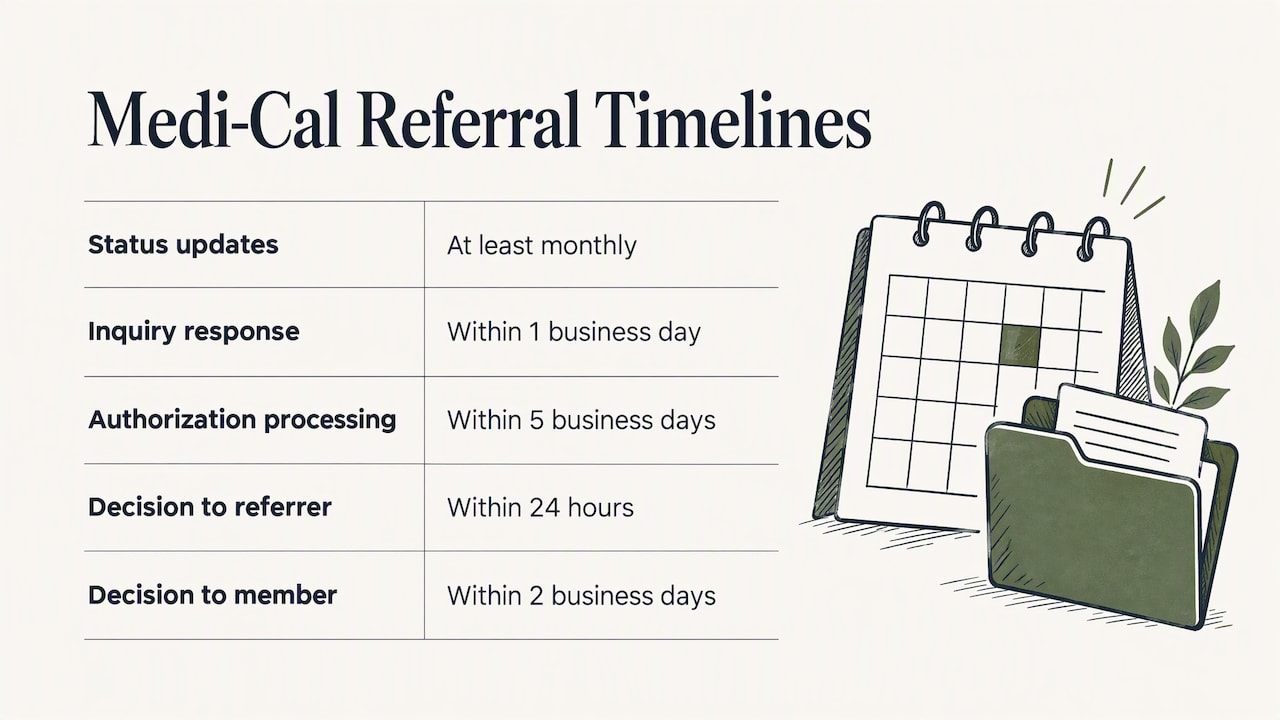
Public programs set concrete timing. In California’s Medi-Cal closed-loop rules, managed-care plans must collect referral status updates from service providers at least monthly and follow up when a status is not updated on that schedule. Plans must also acknowledge a referral inquiry and give the current status within one business day. Referrals tied to authorization requests must be processed within five business days, with the decision passed to the referring entity within 24 hours and to the member within two business days, per the same DHCS guidance.
Those are Medi-Cal rules, not national standards, and they answer a common question: how long does approval take? It depends on the payer and the program. A private-pay admission can move in hours. A payer authorization can take days. Track the actual elapsed time per payer, and the pattern appears quickly.
DHCS also notes that a plan can close a loop as “Services Received” once the provider confirms services were rendered, so the closure itself rests on provider confirmation. The principle holds anywhere: confirmation from the receiving side, not an assumption from the sending side.
Privacy: HIPAA, state law and 42 CFR Part 2
A referral tracker that holds protected health information has to meet the HIPAA Privacy and Security Rules and applicable state law. DHCS’s guidance calls for secure, legally compliant processes for receiving, storing, using and transmitting the data, including a compliant alternative when standard secure transmission is unavailable.
Substance use disorder records add a layer. Where records are federally protected, 42 CFR Part 2 may also apply. HHS published a final rule updating Part 2 in February 2024, and its fact sheet is the place to check current requirements.
Practical habits that reduce risk:
-
Collect the minimum identifiers needed to coordinate.
-
Give access by role, so a BD rep does not see what an admissions lead sees.
-
Keep clinical notes in the clinical record and operational status in the tracker.
-
Confirm consent requirements with compliance counsel or a privacy officer before sharing SUD information across organizations.
Compliance questions about a specific program belong with a healthcare attorney or the organization’s privacy officer. Software does not decide them.
Spreadsheet, EHR module or referral workspace
Most teams start with a spreadsheet and a shared inbox. That works for a handful of referrals a week with one person watching. It starts to fail when two people touch the same referral, when someone is out, or when the manager asks for a closure rate.
The options fall into three types:
-
Spreadsheets and shared inboxes. Free and flexible. No reminders, no audit trail, no role-based access.
-
EHR referral modules. Strong on the clinical side. Often built for referrals inside one health system, not across outside programs, sober living homes or consultants.
-
Dedicated referral workspaces. Built around ownership, status and follow-up, and usually able to sit next to an EHR or CRM.
The right choice depends on volume, on how many outside programs are involved, and on who needs to see what.
Where Teryli fits
Teryli is an operational coordination workspace for behavioral health teams. Each referral keeps a named owner, a current status and a next follow-up date in one shared place, and the workspace sits alongside the clinical record instead of replacing it. Teams can also search the Program Directory to research programs. Pricing is flat by organization or office, never by referral, and current plans are on the Teryli pricing page.
Getting started this week
-
Pick one service line or one referral source.
-
List the statuses the team already uses informally, then cut them to the table above.
-
Name an owner for every open referral today.
-
Set a follow-up date on each one.
-
After 20 referrals, count how many closed, where they stalled, and how long each step took.
That is enough to show whether tracking is the bottleneck, and where to spend effort next.
FAQ
What does patient referral mean in medicine?
A patient referral is a request from one provider or team for another provider or service to see a patient. In behavioral health, that can be a move from assessment to residential treatment, to outpatient care, or to sober living. Tracking confirms the patient actually connects.
How long does it take for a referral to be approved?
It depends on the payer and program. Under California’s Medi-Cal closed-loop rules, plans must process referrals tied to authorization requests within five business days. Other payers and states set their own timelines, so measure the actual elapsed time for each one.
Can a provider say no to a referral?
Yes. Receiving providers can accept or reject referrals. In the VA community care workflow, a rejection requires a return reason. Logging the reason lets the referring team redirect quickly and see why programs decline.
What should a referral tracking log include?
At minimum: the referral source, the receiving program, urgency, dates received and sent, current status, a named owner, the next action with a follow-up date, and the final outcome with a reason. Clinical detail stays in the clinical record.
Sources
Recommended
General information, not clinical or legal advice.