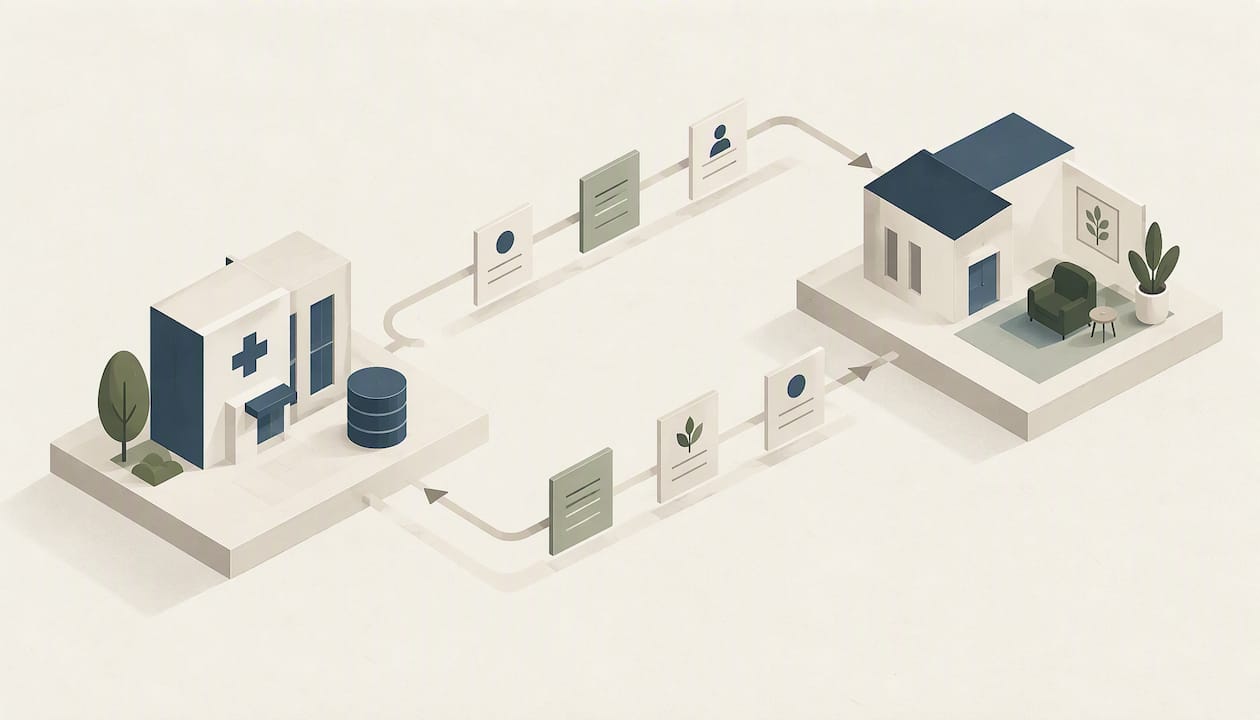
EHR and CRM integration connects the clinical record with the system that runs relationships and referrals, so data moves between them instead of being typed twice. In behavioral health, the useful version is narrow. The EHR stays the source of truth for clinical documentation. The referral or CRM layer holds who sent the referral, who owns it, what happens next and when. Only the fields each side needs cross the line, and substance use disorder records get extra protection.
This guide covers what the two systems each do, which data should flow, how a referral moves through an integrated workflow, what HIPAA and 42 CFR Part 2 require, and how to plan the technical work.
TeryliKeep Behavioral Health Referrals in ViewTeryli helps behavioral health teams find programs and track referral information, statuses, actions, and follow-ups in a dedicated workspace.Explore TeryliTL;DR
-
An EHR is not a CRM. The EHR documents care. The CRM or referral system tracks relationships, outreach and status.
-
Integrate the minimum: referral source, status, owner, dates, disposition. Keep clinical detail in the EHR.
-
Referral status needs a closed loop: scheduled, missed, cancelled, completed, response sent.
-
HIPAA applies to all of it. SUD records add 42 CFR Part 2 consent and segmentation rules.
-
Plan the connection type early: direct API, middleware, or a workspace that sits alongside the record. Test routinely.
Table of Contents
What each system does
The two systems are built for different jobs. Confusing them is the first cause of failed projects.
The federal eCQI Resource Center defines an EHR as a digital record of a patient’s health information created over time across visits and care settings. It can include demographics, progress notes, problems, medications, vital signs, history, lab results, diagnoses, treatments and allergies. The Health IT Playbook describes an EHR as software used to securely document, store, retrieve, share and analyze information about individual patient care.
A healthcare CRM manages the work around the visit. Salesforce’s guide says CRMs handle patient engagement, communication and operational workflows outside of clinical visits, while EHRs focus on documentation, history and treatment plans. Its separate EHR guide states plainly that EHRs are not CRM systems and work better when the two are integrated.
In behavioral health, the CRM role is often filled by something more specific than a general CRM: a referral management tool. The questions it answers are operational:
-
Who referred this person?
-
Which program received the referral?
-
Who on the team owns the next step?
-
Was the family called back?
-
Did the referral convert, stall or close?
An EHR does not answer those well. A spreadsheet answers them badly once volume grows.
Why integrate at all
Without integration, staff retype the same facts in two places. Names, dates of birth, contact details and referral source get entered at intake, then again in the clinical record. Every retype is a chance for a mismatch.
Two published examples show the scale of the effect, with the caveat that both are single-organization reports, not benchmarks:
-
Healthcare IT News reported that MIMIT Health connected its EHR and Salesforce CRM to share demographics, scheduling, billing and clinical data, and reported saving two hours of data entry per patient per day.
-
A Salesforce AppExchange client story describes Ambrosia Treatment Center saving about 10 minutes per patient per day by removing dual entry between its EHR and CRM.
The gap between those two figures is a reminder that results depend on how much data moves and how much was duplicated before. Time saved is the smaller benefit. The larger one is that referral status stops living in inboxes and personal notes.
What data should flow, and in which direction
The common mistake is syncing everything. A narrower design is easier to secure, easier to maintain and easier to explain to a compliance officer.
| Data | Typical direction | Why |
|---|---|---|
| Demographics and contact details | Referral system to EHR at admission | Avoids retyping at intake |
| Referral source and referrer contact | Stays in referral system | Relationship data, not clinical |
| Referral status and owner | Stays in referral system | Operational, drives follow-up |
| Appointment or admission date | Two-way | Closes the loop on scheduled, missed, cancelled |
| Disposition (admitted, waitlisted, declined, referred out) | EHR or admissions to referral system | Lets the referrer get an answer |
| Clinical notes, diagnoses, medications | Stays in EHR | Minimum necessary, plus Part 2 exposure |
| SUD-specific records | Only with valid consent and segmentation | 42 CFR Part 2 |
The rule of thumb: if a field is needed to decide who calls whom tomorrow, it belongs in the referral layer. If it is needed to treat the person, it belongs in the EHR.
What a closed referral loop needs
Integration matters most where referrals go missing. The CMS closing-the-loop guidance says a referral workflow should track each referral through completion. It should also communicate the disposition, appointment date and time, inability to schedule, cancellations and no-shows, then send a clear response note after the visit.
A peer-reviewed study in JAMIA describes an enhanced referral system tied to scheduling. It could update status when appointments were made, missed or cancelled, flag referrals delayed in a stage, and link the consultant’s note to the referral for one-click review. That is the target for behavioral health too, with the clinical note replaced by a disposition and a minimal summary the consent allows.
A practical status set:
-
Received
-
Screening or review
-
Pending information
-
Offered a bed or appointment
-
Scheduled
-
Admitted or seen
-
Declined, waitlisted or referred out
-
Response sent to referrer
-
Closed
Each status has one owner and a next action with a date. A referral without an owner is a lost referral waiting to be discovered.
A day in an integrated workflow
The flow below is generic. It shows where the two systems hand off.
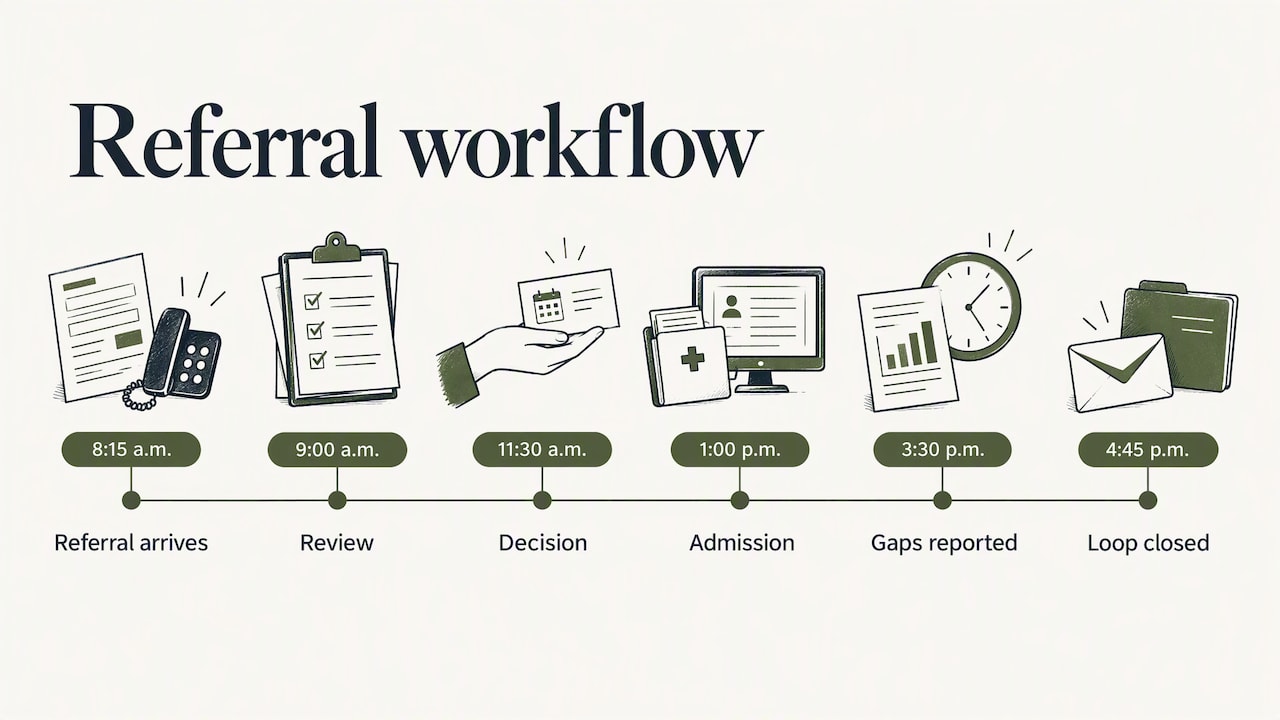
8:15 a.m. Referral arrives. A case manager or consultant sends a referral by phone, email or directory. Intake logs it in the referral workspace with source, program and owner.
9:00 a.m. Review. Admissions checks fit and availability. Status moves to screening. Questions to the referrer are logged as follow-ups with due times.
11:30 a.m. Decision. The program offers a spot. The referrer is notified from the referral record, not from memory.
1:00 p.m. Admission. Demographics pass to the EHR through the integration. Clinical staff open the chart already populated. The referral status updates to admitted.
3:30 p.m. Gaps. A report lists referrals untouched for 48 hours, with owners. Business development sees which referrers are waiting on a response.
4:45 p.m. Loop closed. The disposition goes back to the referrer. The referral closes with a date.
No step required a second data entry of the same identifiers, and no clinical note left the EHR.
HIPAA and 42 CFR Part 2
Behavioral health organizations carry two overlapping rule sets. Both shape what an integration may move.
HIPAA. HHS says the Privacy Rule applies to covered health plans, clearinghouses and providers conducting specified electronic transactions. It requires safeguards for protected health information and limits uses and disclosures without authorization. Any referral tool holding PHI for a covered entity should be assessed against those safeguards, including a business associate agreement where the vendor handles PHI on the organization’s behalf.
42 CFR Part 2. Records of substance use disorder treatment from Part 2 programs have their own confidentiality rule. ONC’s educational module for behavioral health providers says organizations must follow HIPAA and protect SUD records under 42 CFR Part 2, and notes that ONC certification criteria include data segmentation for privacy. HHS announced a final rule modifying Part 2 in February 2024 to align parts of it with HIPAA, and the compliance deadline was February 16, 2026. Consent language and redisclosure practices should be reviewed with counsel against the current rule.
Two technical capabilities follow from this. The Health IT Playbook lists data segmentation to sequester sensitive information and audit logs among behavioral health IT capabilities. A peer-reviewed review also says EHRs should support HIPAA, Part 2 and patient consent through segmentation. For an integration, that translates into:
-
Role-based access in the referral layer, so only assigned staff see a referral
-
Consent status captured before any record is shared
-
Audit logs on views, edits and exports
-
No SUD treatment content pushed into general-purpose fields or notifications
The decision of what may be disclosed belongs to the organization’s privacy officer and legal counsel, not to the software.
Technical options and what to plan for
Three connection patterns are common.
Direct API. The referral system calls the EHR’s interface. Fastest to run once built, but depends on what the EHR vendor exposes and charges for.
Middleware or integration engine. A layer translates and routes messages. More moving parts, but one connection can serve several systems.
Alongside the record. The referral workspace does not write into the chart at all. Staff or a light export move a few fields at admission. Lowest risk and quickest to start.
SCNSoft’s overview lists the technical choices as HL7 or FHIR standards and direct API versus middleware. The AHRQ Integration Academy advises involving IT staff in vendor evaluation, assessing API and middleware options and testing routinely to catch interoperability problems. The same page notes that configured clinical decision support in an EHR can prompt behavioral health screenings, which is a reason to keep screening logic in the EHR and referral logistics outside it.
A checklist before signing anything:
-
List the five to ten fields that must cross, and name the source of truth for each.
-
Decide one-way or two-way per field.
-
Ask the EHR vendor what integration access exists, what it costs and how long it takes.
-
Confirm how Part 2 data is segmented and who can override it.
-
Define a test plan: sample records, mismatched names, duplicates, cancelled referrals.
-
Assign an owner for the integration after go-live.
-
Set a review at 30 and 90 days: error rates, unowned referrals, time to first response.
Most integration projects in this field start from the wrong question. The question is rarely how to get everything into the EHR. It is where a referral stands today and who is responsible for it.
A practical first project: move a few fields at admission and one disposition back, prove the loop closes, then widen. Most of the retyping disappears with that small scope, and complexity can be added once the loop works.
Where Teryli fits
Teryli gives behavioral health teams a referral workspace with ownership, follow-ups and status tracking, plus a Program Directory to search. It sits alongside the clinical record instead of replacing it, and any EHR or CRM integration is scoped with each customer. Pricing is flat by organization or office, never by referral, and current plans are on the Teryli pricing page.
Common pitfalls
-
Syncing too much. Every extra field adds risk and maintenance. Start small.
-
No data owner. When two systems both hold a phone number, one must win.
-
Ignoring duplicates. Merge rules for repeat referrals should exist before launch.
-
Treating status as free text. A fixed status list is what makes reports possible.
-
Forgetting the referrer. A closed loop includes the response back to the person who sent the referral.
-
Skipping the privacy review. Part 2 questions are cheaper to settle before data moves than after.
FAQ
Is an EHR a CRM?
No. An EHR is built for clinical documentation, history and treatment plans. A CRM is built for relationships, communication and the steps around care. They work best as separate systems that exchange a defined set of data.
What does EHR and CRM integration mean in behavioral health?
It means the clinical record and the referral or relationship system share selected data automatically. Typically demographics and dates move toward the EHR at admission, and dispositions move back to the referral record. Clinical notes and SUD content stay in the EHR unless consent and segmentation allow otherwise.
Which data should a referral system receive from the EHR?
Only what the referral team needs to act: appointment or admission date, no-show or cancellation, and final disposition. CMS closing-the-loop guidance lists those same events as the core of referral tracking. Diagnoses and notes should stay out unless a documented consent and a specific purpose support sharing.
Does 42 CFR Part 2 block integration?
No, but it limits what can be shared and with whom. Records from Part 2 programs need valid consent and careful segmentation, and the compliance date for the 2024 final rule was February 16, 2026. A privacy officer or healthcare attorney should approve the data map before launch.
Do we need a full integration to start?
Not necessarily. A referral workspace used alongside the EHR can remove most missed follow-ups on its own. Add automated exchange once the status list, owners and consent process are working.
Sources
-
Ambrosia Treatment Center client story, Salesforce AppExchange
-
Closing the loop with an enhanced referral management system, JAMIA via PMC
-
Understanding the Value of Health IT, educational module for behavioral health providers, ONC
-
February 16, 2026: Compliance Deadline for Part 2 Final Rule, HIPAA Journal
-
Leverage Technology for Integrated Behavioral Health, AHRQ Integration Academy
Recommended
General information, not clinical or legal advice.